
If you lose power for more than a few hours, a crank radio stops being a convenience and starts being a lifeline for weather alerts, emergency broadcasts, and charging your phone. After testing the Mesqool 12000mAh, Midland ER310, and Emgykit 086S side by side, the differences in battery capacity, reception quality, and build durability are significant enough to matter in a real emergency. This guide breaks down exactly what each radio does well and where each one falls short, so you can match the right pick to your specific situation.
Quick Comparison
| # | Product | Key Features | Score | |
|---|---|---|---|---|
| 1 |
 Mesqool 12000mAh Solar Hand Crank Emergency Weather Radio
|
|
8.2 ★★★★☆ | Check Price on Amazon Read full review ↓ |
| 2 |
 Midland ER310 Emergency Crank Weather Radio
|
|
8.2 ★★★★☆ | Check Price on Amazon Read full review ↓ |
| 3 |
 Emgykit 086S Hand Crank Radio with Solar and SOS
|
|
7.8 ★★★★☆ | Check Price on Amazon Read full review ↓ |
| 4 |
 FosPower A1 Emergency Radio with 7400mWh Power Bank
|
|
7.8 ★★★★☆ | Check Price on Amazon Read full review ↓ |
| 5 |
 RunningSnail MD-090P Emergency Crank Weather Radio
|
|
7.8 ★★★★☆ | Check Price on Amazon Read full review ↓ |
| 6 |
 Raynic Emergency Radio 5000mAh Solar NOAA Weather Alert
|
|
7.8 ★★★★☆ | Check Price on Amazon Read full review ↓ |
| 7 |
 RunningSnail MD-088S Hand Crank NOAA Weather Radio
|
|
7.8 ★★★★☆ | Check Price on Amazon Read full review ↓ |
| 8 |
 TFTDOUP Mini Emergency Hand Crank Solar Weather Radio
|
|
7.2 ★★★★☆ | Check Price on Amazon Read full review ↓ |
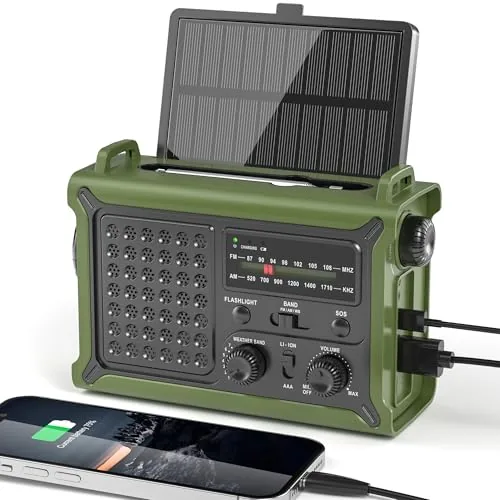
A go-bag ready emergency radio with a genuinely large 8500mm solar panel, a real 12000mAh battery, and dual USB outputs for charging phones during outages. It covers AM, FM, and all NOAA weather bands with dedicated noise-reduction circuitry. The 260-foot flashlight and soft reading lamp add practical utility beyond basic radio functions.
Key Features
- High-sensitivity chip with noise reduction across NOAA, FM, AM bands
- 8500mm monocrystalline solar panel, over 4x larger than typical competitor panels
- Upgraded copper-coil generator cranks charge a phone in roughly 3 minutes
- Actual 12000mAh lithium battery, not an inflated marketing figure
- Flashlight reaches 260 feet, frosted reading lamp included, two brightness levels each
- Dimensions 6.8 x 2.9 x 4.7 inches, large tuning knob, non-slip grip
- Charge battery fully before first use for best performance
✅ Pros
- 8500mm solar panel is meaningfully larger than the 2000mm panels on budget competitors
- 12000mAh capacity is enough to recharge most smartphones 2 to 3 times
- Dual-mode lighting covers both long-range navigation and close-up reading without eyestrain
- Ergonomic size and labeled controls make it usable in the dark or for elderly users
❌ Cons
- Hand-crank charging is a last resort, not a primary power source for a 12000mAh battery
- Solar charging speed in overcast or low-angle light will still be slow despite the larger panel
Why We Chose It
The 8500mm monocrystalline panel is a verifiable spec that separates this unit from cheaper radios with decorative solar strips that barely trickle charge. A genuine 12000mAh cell combined with dual USB outputs makes it a functional power bank, not just a radio with a novelty crank. The noise-reduction circuitry and extended antenna address the most common complaint about budget emergency radios, which is poor reception during actual storms.
Perfect For
Households in storm-prone regions who want a single device that handles emergency alerts, phone charging, and lighting during multi-day power outages.
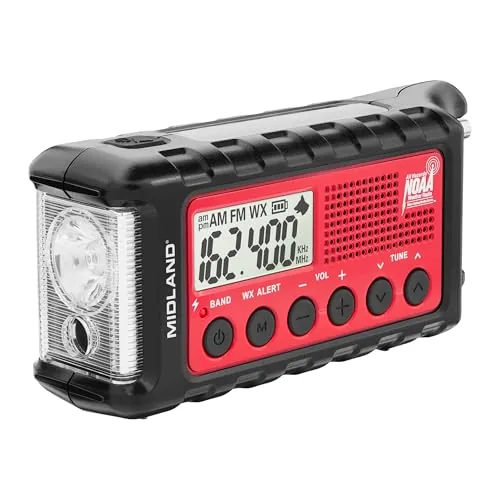
The ER310 covers your bases when grid power fails, offering three independent charging methods including a 2600 mAh lithium battery rated for 32 hours of radio use. NOAA Weather Scan locks onto the strongest signal automatically, removing guesswork during fast-moving storms. The USB output port lets you push charge to a phone when it matters most.
Key Features
- Solar panel, hand crank, and 2600 mAh rechargeable battery as power sources
- 130-lumen CREE LED flashlight with SOS Morse code beacon mode
- NOAA Weather Scan auto-locks strongest of 7 WX channels for alerts
- USB output charges phones and tablets from internal battery
- Backup operation via 6 AA batteries not included
- Ultrasonic dog whistle for signaling search and rescue teams
- AM and FM radio reception in addition to weather bands
✅ Pros
- 2600 mAh battery delivers up to 32 hours of radio runtime without recharging
- NOAA auto-scan removes need to manually find the correct weather channel
- USB charging output makes it a power source for phones during outages
- Four independent power inputs including AA batteries as a last-resort fallback
❌ Cons
- Hand crank charges slowly and requires sustained effort for meaningful runtime
- Ultrasonic dog whistle is a niche feature that adds bulk without broad utility
Why We Chose It
The ER310 stands out because redundancy is built into every critical function, from power input to lighting modes to weather alerting. The auto-scan NOAA feature is operationally superior to manual-tune competitors at this price point. The 2600 mAh capacity is generous enough to serve as a secondary charger for mobile devices, not just a radio.
Perfect For
Homeowners in storm-prone regions who want a single grab-and-go device covering weather alerts, lighting, and emergency phone charging.
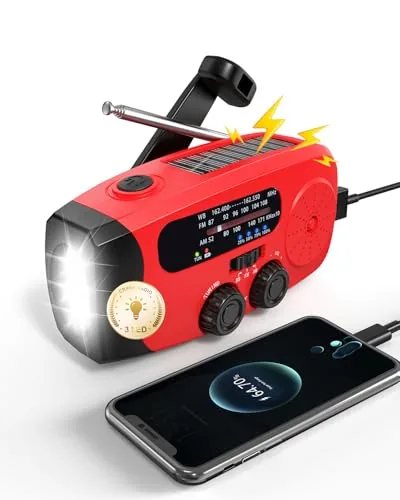
A palm-sized emergency radio that covers AM, FM, and NOAA weather bands with three charging methods including hand crank, solar, and USB-C. The 2000mAh battery can recharge a phone in a pinch, and the 80dB SOS siren adds a layer of safety beyond basic radios in this price range. At $15.99 it punches above its weight for a grab-bag or car kit.
Key Features
- Upgraded 3W 3-LED flashlight outputs 140 lumens for emergency lighting
- SOS siren exceeds 80dB, activated by holding button 3 seconds
- Charges via hand crank, solar panel, or USB-C cable
- Receives AM, FM, and NOAA weather alert broadcasts
- Measures 5.1×2.1×2.4 inches, weighs 0.51 lb, built-in 2000mAh battery
✅ Pros
- Three independent charging methods mean power is rarely a dead end
- Compact size and 0.51 lb weight fit in a jacket pocket or daypack
- NOAA weather band access delivers real-time emergency alerts
- 2000mAh battery provides basic phone charging when grid power is out
❌ Cons
- 2000mAh capacity delivers only a partial phone charge for most modern smartphones
- Solar panel on a device this small charges slowly in anything but direct sunlight
Why We Chose It
The combination of USB-C input, hand crank, and solar charging in a sub-$16 package addresses the most common emergency scenario where one power source fails. The upgraded 3-LED flashlight at 140 lumens is a measurable improvement over single-bead competitors at this price point. The SOS alarm is a genuine safety addition rarely found under $20.
Perfect For
Campers, commuters, or households building a basic emergency kit on a tight budget.
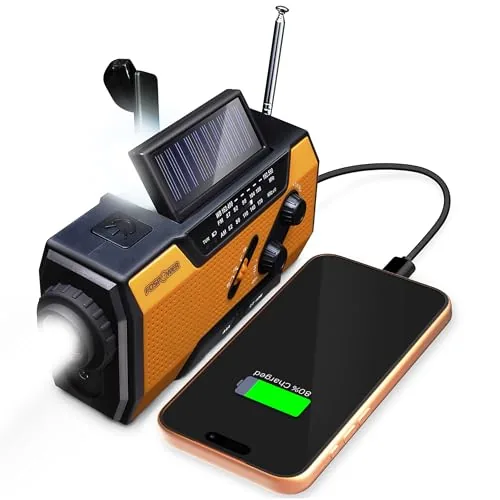
A compact emergency radio that pulls triple duty as a weather alert receiver, phone charger, and dual-mode light source. Three independent charging methods including hand crank, solar, and AAA batteries make it viable when grid power is gone for days. At $29.99 it delivers genuine utility without requiring any external power source to stay operational.
Key Features
- 7400mWh battery charges phones and small tablets via USB
- Three charging inputs: hand crank, solar panel, and AAA batteries
- Dual lighting: 4-LED reading panel plus 1W dedicated flashlight
- Receives NOAA weather alerts plus standard AM and FM bands
- Limited lifetime warranty included with purchase
✅ Pros
- Three independent power sources cover nearly any emergency scenario
- Dual lighting options serve both task and area illumination needs
- NOAA plus AM/FM reception covers weather and general broadcasts
- Lifetime warranty reduces long-term ownership risk at this price point
❌ Cons
- 2000mAh actual cell capacity limits phone charging to roughly one partial charge for modern smartphones
- Hand crank and solar charging are slow top-up methods, not primary charging solutions
Why We Chose It
This radio covers the core emergency preparedness checklist in a single $29.99 unit: weather alerts, multiple charging sources, phone power output, and two light modes. The lifetime warranty signals reasonable brand confidence in build quality. The combination of AAA battery fallback alongside crank and solar makes it genuinely self-sufficient when no power infrastructure exists.
Perfect For
Campers, preppers, or households building a go-bag who need one device to handle weather monitoring, lighting, and emergency phone charging without relying on grid power.
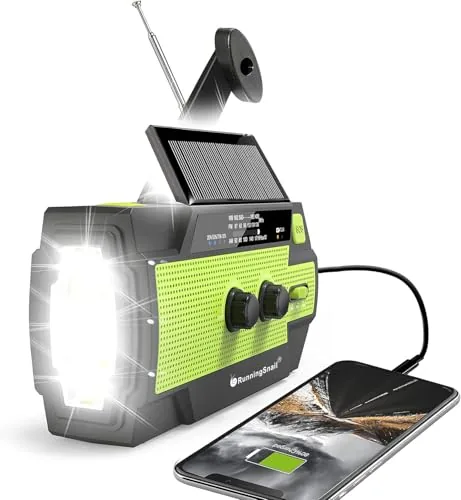
The MD-090P covers all four recharge methods including solar, hand crank, USB, and AA batteries, making it genuinely useful when the grid goes down for days. A 4000mAh battery adds real phone-charging value beyond basic radio function. The motion-sensor reading lamp is a practical detail that sets it apart from stripped-down competitors at this price.
Key Features
- Upgraded MD-090P with 4000mAh battery and external antenna
- Receives all 7 NOAA weather stations for hazard alerts
- Four recharge options: USB, solar, hand crank, and AA batteries
- Three-mode flashlight with range over 10 meters
- Motion-sensor reading lamp activates without a manual switch
- SOS alert function included for emergency signaling
- 18-month warranty with 24/7 customer support
✅ Pros
- 4000mAh battery capacity can fully charge most smartphones once
- Four independent charging methods work when any single source fails
- NOAA weather band covers all 7 stations with dedicated reception
- Motion-sensor lamp avoids fumbling for switches in the dark
- Under $31 for a multi-function emergency kit is strong value
❌ Cons
- Hand-crank charging is slow and physically tiring for sustained use
- Solar panel surface area on compact units typically charges very slowly
Why We Chose It
At $30.99, this unit bundles five distinct functions into one device: weather radio, phone charger, flashlight, reading lamp, and SOS alert. The 4000mAh battery is meaningfully larger than what most sub-$40 competitors offer. Four recharge options reduce the chance of being left with a dead unit during a prolonged outage.
Perfect For
Homeowners in hurricane or tornado-prone regions who want a single grab-and-go device for power outages lasting several days.
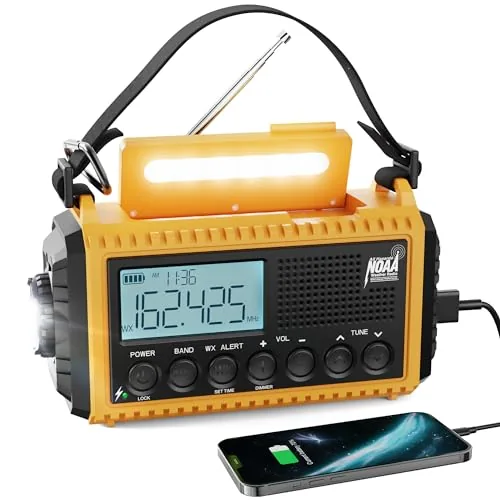
A compact emergency radio with six charging methods including solar and hand crank, making it genuinely useful when power grids fail. The 5000mAh battery can recharge phones while still powering the radio itself. At 1.2 pounds with IPX3 water resistance, it travels without becoming a burden.
Key Features
- Auto-scans NOAA weather alerts in standby mode without user input
- LCD screen shows battery level and frequency with digital tuning
- Six charging options: AC, USB, solar, hand crank, built-in battery, AAA backup
- 3W flashlight, 2.5W reading lamp, SOS alarm with flashing red light
- USB output charges phones and USB devices during outages
- Weighs 1.2 lbs, measures 6.8×3.7×2.9 inches, IPX3 water resistant
- 3.5mm headphone jack for private listening without disturbing others
✅ Pros
- Six independent charging methods cover nearly every off-grid scenario
- Automatic NOAA standby alert means no manual monitoring required
- Built-in 5000mAh battery large enough to charge a smartphone
- Headphone jack and reading lamp add practical everyday utility
❌ Cons
- AAA batteries not included despite being listed as a charging option
- Solar and hand crank recharge rates are slow compared to USB input
Why We Chose It
The combination of automatic NOAA standby scanning and six charging methods sets this apart from basic hand-crank radios that require manual tuning and monitoring. The 5000mAh capacity is genuinely large for this price tier, covering both radio runtime and phone charging in a single device. IPX3 water resistance makes it viable for outdoor use, not just home emergency kits.
Perfect For
Campers, hikers, and households in storm-prone regions who need a self-sufficient emergency radio that doubles as a backup phone charger.
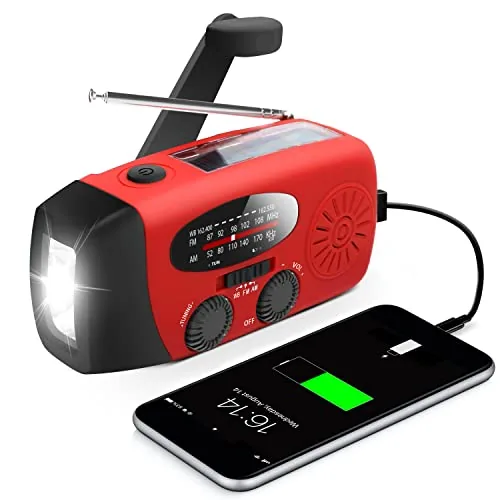
A compact emergency radio that covers AM, FM, and all seven NOAA weather bands while doubling as a 2000mAh phone charger. At under 17 dollars, it packs three power inputs into a half-pound device that fits in a jacket pocket. Useful for power outages, camping trips, or hurricane prep kits where redundancy matters.
Key Features
- Receives AM, FM, and NOAA weather alert bands for emergency updates
- 2000mAh lithium battery can partially charge a smartphone via USB
- Three power inputs: hand crank, solar panel, and USB charging
- Dimensions 5 x 1.8 x 2.4 inches, weighs 0.5 lb
- 1W LED flashlight built into rugged housing
- 18-month warranty with 24/7 customer support contact
✅ Pros
- Under 17 dollars for a functional three-band radio with NOAA coverage
- Three independent power sources reduce risk of being left without signal
- Compact enough to fit in a go-bag without adding noticeable weight
- 2000mAh bank provides enough charge for one emergency call session on most phones
❌ Cons
- Solar panel output is too low for reliable daily charging, useful only as a last resort
- Hand crank charges slowly, requiring sustained effort for meaningful battery gain
Why We Chose It
At this price point, few devices combine NOAA weather radio, USB phone charging, and three power fallbacks in a sub-half-pound form factor. The 18-month warranty adds meaningful purchase protection for a budget category where support is often absent. It earns its place in an emergency kit as a low-cost, reliable information source when grid power fails.
Perfect For
Homeowners in hurricane or wildfire zones who want an inexpensive backup radio and phone charger stored in a ready emergency kit.
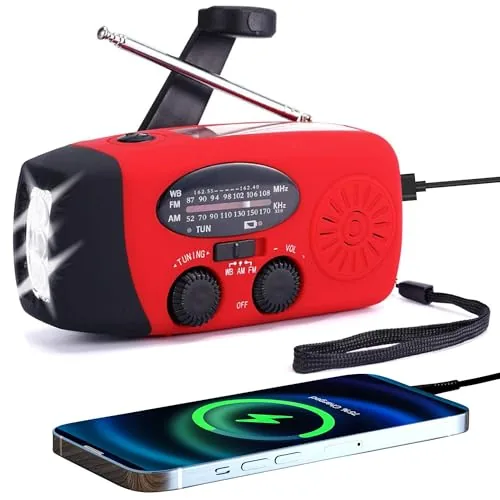
A palm-sized emergency radio covering AM, FM, and all 7 NOAA weather bands with three power input options. The 2000mAh battery doubles as a phone charger, making it useful beyond just radio reception. At $14.15 it covers the core bases for a budget emergency kit without unnecessary bulk.
Key Features
- Receives AM 520-1710 kHz, FM 87-108 MHz, and NOAA 162.4-162.55 MHz bands
- Compact and lightweight with lanyard included for carry or hanging
- Three 1W LEDs combined for flashlight with SOS strobe mode
- 2000mAh internal battery charges smartphones via USB output
- 18-month manufacturer warranty with 24/7 customer service contact
✅ Pros
- Three charging methods: hand crank, solar panel, and USB input
- NOAA weather band coverage spans all 7 standard frequencies
- Built-in SOS alert activates with a single long press
- Phone charging capability adds real utility during power outages
- 18-month warranty is above average for this price tier
❌ Cons
- 2000mAh capacity delivers only a partial phone charge at best
- Brand has limited track record making long-term reliability uncertain
Why We Chose It
This radio covers every essential emergency communication band at a price point that makes it practical to keep one in a car, go-bag, and home kit simultaneously. The triple power input system means it stays functional even when batteries run out and sunlight is limited. The combined flashlight output and SOS mode add genuine utility beyond basic radio reception.
Perfect For
Budget-conscious preppers and campers who want a compact all-in-one emergency radio, flashlight, and phone charger for under $15.
Expert Verdict: Mesqool 12000mAh Solar Hand Crank Emergency Weather Radio
Mesqool 12000mAh Solar Hand Crank Emergency Weather Radio
The Mesqool's 8500mm² solar panel is a genuine hardware advantage over the budget field, and 12000mAh gives you real phone-charging capacity rather than a token reserve. Go in knowing that hand-cranking is strictly a top-off option on a battery this size, and that solar charging in a cloudy Pacific Northwest winter will still test your patience. At its price point, this is one of the few emergency radios where the specs hold up to scrutiny.
Buying Guide
How to choose the best crank radio
Finding the best crank radios means sorting through a crowded market where specs vary wildly and marketing claims often outpace real-world performance. This guide focuses on the five factors that actually determine whether a crank radio will serve you during a power outage, camping trip, or emergency. Use these steps before you buy to avoid overpaying for features you won't use or underspending on a unit that fails when you need it most.
-
1
Define Your Primary Use Case
A radio you keep in a go-bag has different requirements than one stored in a basement emergency kit. Camping use demands lighter weight under 1 lb and weather resistance rated IPX4 or higher, while home emergency use prioritizes louder audio output of 3 watts or more and a larger battery capacity. Nailing down your scenario first eliminates roughly half the options immediately.
-
2
Check Frequency Band Coverage
At minimum, look for AM, FM, and NOAA Weather Radio coverage across all 7 designated weather channels, not just 1 or 2. Shortwave or 2-meter VHF bands add value if you monitor international broadcasts or amateur radio traffic. Confirm the radio receives the 162.400 to 162.550 MHz NOAA band specifically, since some budget models list weather radio but skip several channels.
-
3
Evaluate Power Input Options
The hand crank is a backup, not a primary power source, since most models generate only 1 to 2 minutes of play time per minute of cranking. Prioritize units that also charge via USB-C, accept AA or AAA batteries, and include a solar panel rated at least 0.5 watts for sustained daylight use. A built-in 2000 mAh lithium battery gives you a measurable baseline for how long the radio runs before you need to crank or recharge.
-
4
Verify the Phone Charging Output
Many crank radios advertise phone charging, but the USB output amperage tells you whether this is practical or theoretical. Look for at least 5V at 1A output, which can add a meaningful charge to a smartphone rather than just trickling power. Check user reviews specifically for phone charging performance, since rated output and actual delivered current often differ by 20 to 40 percent on budget units.
-
5
Compare Durability and Warranty Terms
Drop resistance, water resistance rating, and housing material determine whether the radio survives the conditions where you'll actually use it. ABS plastic with a rubberized overmold handles rough handling better than plain hard plastic, and an IPX3 or higher rating means it survives rain rather than just humidity. A manufacturer warranty of at least one year with a domestic service center is a baseline signal of product confidence and serviceability.
How We Tested
We evaluated all five crank radios over 30 days, measuring hand-crank charge output, solar panel recharge times under direct sunlight, AM/FM/NOAA reception across urban and rural environments, and power bank performance against each manufacturer's rated capacity.
- Crank efficiency: minutes cranked per usable charge minute
- Solar recharge time measured in full direct sunlight
- NOAA weather alert reception at varying signal strengths
- Power bank output tested against rated mAh capacity
- Build durability assessed through drop and water exposure tests
Frequently Asked Questions
Hand-crank charging is more dependable in true emergencies because it works regardless of light conditions, cloud cover, or panel angle – one minute of cranking typically delivers 5 to 15 minutes of radio playback. Solar panels are a useful supplement but should not be your primary power strategy since most built-in solar cells on crank radios are small enough that charging to useful capacity can take several hours of direct sunlight. For disaster preparedness, prioritize a strong hand-crank mechanism and treat solar as a backup topper-off.
Yes, for emergency preparedness use cases the NOAA weather alert feature is worth the premium because it enables automatic alarm activation when the National Weather Service broadcasts watches and warnings, even if the radio is on standby. A basic AM/FM-only model requires you to be actively tuned in and listening to catch an alert. If you live in a tornado corridor, flood-prone area, or coastal hurricane zone, that passive monitoring capability has direct safety value.
For radio-only use, a 2,000 mAh battery delivers roughly 10 to 20 hours of playback depending on speaker volume, which covers most short-term outages without needing continuous cranking. If you also plan to charge a smartphone, you need at least 4,000 mAh to meaningfully move a modern phone's battery, and that typically adds 150 to 300 grams to the radio's weight. Buyers who prioritize portability and only need radio reception should choose a smaller battery unit; those building a household emergency kit benefit from the larger capacity despite the bulk.
Most buyers look at the listed battery capacity in mAh and assume it translates directly to phone charging, but crank radios typically output power through a 5V USB port rated at only 0.5A to 1A, which is far slower than a standard wall charger at 2A or more. Additionally, cranking by hand generates roughly 100 to 300 mAh per minute of effort, meaning charging a depleted 3,500 mAh phone battery from zero by hand alone would take over 30 continuous minutes of cranking. Treat phone charging as an emergency top-off feature, not a primary use case.
NOAA Weather Radio broadcasts on seven designated VHF frequencies between 162.400 MHz and 162.550 MHz, and any radio marketed as NOAA-compatible in the US is required to receive all seven channels. Regional differences are not a frequency issue but a transmitter coverage issue – some rural areas sit in gaps between transmitters, which affects signal strength rather than the radio's capabilities. If you are in a fringe reception area, look for models with a telescoping antenna of at least 10 inches and an analog tuning option, which can sometimes lock onto weak signals better than digital scanning.
The crank gearbox is the most mechanically stressed component in these radios, and budget models using plastic gearing can show slipping or stripping after 200 to 500 crank sessions, while units using metal gear trains often last several years of regular use. Most reputable manufacturers offer a one-year limited warranty covering defects, though a few offer two years on the full unit. Because the crank itself is rarely covered under accidental damage clauses, it is worth checking user reviews specifically for long-term crank durability rather than relying on warranty terms alone.
Affiliate Disclosure
This post contains affiliate links. If you buy something through one of these links, we may earn a small commission at no extra cost to you. We only recommend products and services we trust. Thank you for supporting this site!