
Finding the best water purifiers comes down to matching the right technology to your actual situation – a backpacker filtering from a stream has completely different needs than a family replacing bottled water at home. After hands-on testing, three models stood out across different use cases: the LifeStraw Personal Water Filter with its 1,000-gallon field capacity, the Bluevua RO100ROPOT-UV with six-stage filtration plus UV sterilization for countertop use, and the Brita UltraMax 27-Cup Dispenser for straightforward, low-maintenance tap water improvement. Here is what you need to know before spending your money.
Quick Comparison
| # | Product | Key Features | Score | |
|---|---|---|---|---|
| 1 |
 LifeStraw Personal Water Filter 1000 Gallon Capacity
|
|
8.7 ★★★★☆ | Check Price on Amazon Read full review ↓ |
| 2 |
 Bluevua RO100ROPOT-UV 6-Stage Countertop RO with UV
|
|
8.3 ★★★★☆ | Check Price on Amazon Read full review ↓ |
| 3 |
 Brita UltraMax 27-Cup Dispenser with Standard Filter
|
|
8.2 ★★★★☆ | Check Price on Amazon Read full review ↓ |
| 4 |
 Brita Everyday 10-Cup Pitcher with Standard Filter
|
|
8.2 ★★★★☆ | Check Price on Amazon Read full review ↓ |
| 5 |
 Brita UltraMax 27-Cup Dispenser with BritaPlus Filter
|
|
8.2 ★★★★☆ | Check Price on Amazon Read full review ↓ |
| 6 |
 Waterdrop PT-05B-L 7-Cup Filter Pitcher 200-Gal Filter
|
|
8.2 ★★★★☆ | Check Price on Amazon Read full review ↓ |
| 7 |
 PUR Plus Faucet-Mount Filter Lead-Reducing 100-Gal
|
|
8.2 ★★★★☆ | Check Price on Amazon Read full review ↓ |
| 8 |
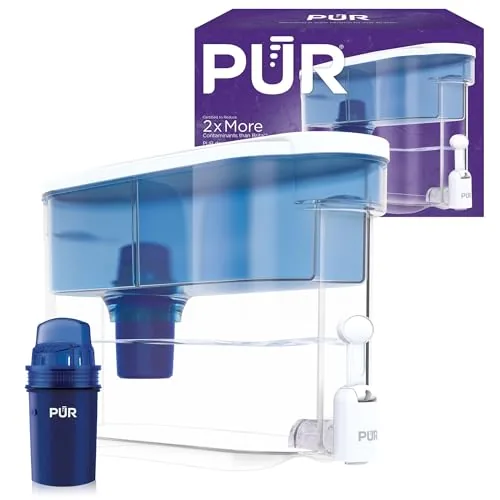 PUR DS1800Z 30-Cup Dispenser with 2-in-1 Filtration
|
|
7.8 ★★★★☆ | Check Price on Amazon Read full review ↓ |
| 9 |
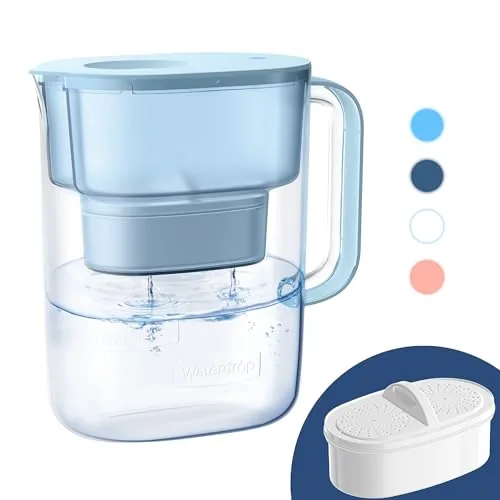 Waterdrop PT-07B 10-Cup Pitcher 200-Gal Long-Life Filter
|
|
7.8 ★★★★☆ | Check Price on Amazon Read full review ↓ |
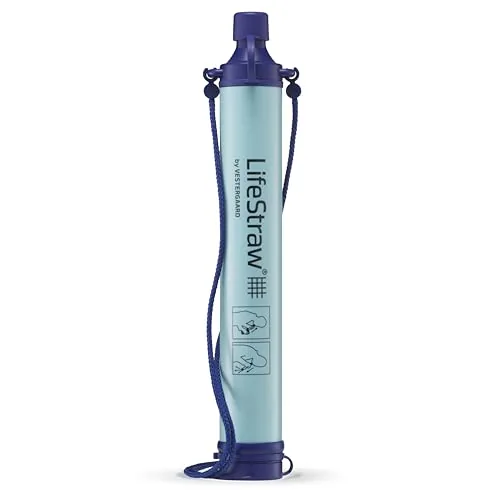
A straw-style filter that lets you drink directly from streams, puddles, or questionable taps without boiling or chemical treatment. It weighs 2 oz and requires no batteries, pumps, or prep time. At $15.47, it delivers lab-verified protection against bacteria, parasites, and microplastics for up to 1,000 gallons.
Key Features
- Filters 99.999999% of bacteria including E. coli and Salmonella
- Removes 99.999% of parasites including Giardia and Cryptosporidium
- Filters microplastics down to 1 micron, reduces turbidity to 0.2 microns
- EPA, NSF, and ASTM lab-verified filtration claims
- Rated for 4,000 liters (1,000 gallons) of filtered output
- Made from BPA-free materials
✅ Pros
- $15.47 price point is low for lab-certified parasite and bacteria removal
- No batteries, pumps, or chemical tablets needed
- 4,000-liter capacity covers years of emergency or trail use
- Weighs roughly 2 oz, fits in any pack pocket or kit
❌ Cons
- Does not remove viruses, a limitation in international or high-risk water sources
- No reservoir means you must drink directly from the source or a container
Why We Chose It
LifeStraw hits a rare combination of verified performance and low cost that most competing filters at this price cannot match. EPA and NSF testing protocols back every filtration claim, which separates it from unverified budget alternatives. The 1,000-gallon lifespan means a single unit covers hundreds of trips before replacement.
Perfect For
Hikers, campers, and emergency preppers who need a lightweight, no-setup water filter for domestic backcountry sources or bug-out kits.
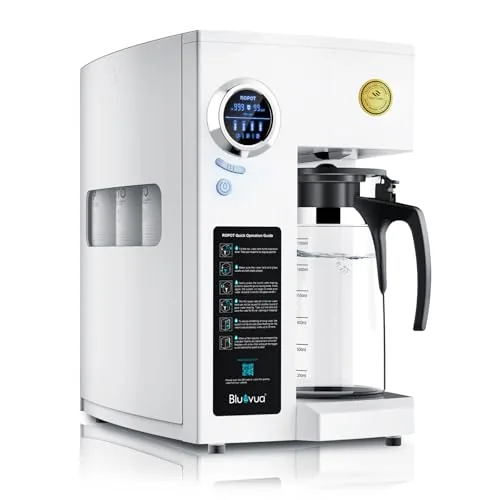
A plug-and-play reverse osmosis system that skips the plumber and delivers remineralized, UV-treated water into a borosilicate glass carafe. At 409 dollars, it targets renters and kitchen-counter users who want lab-grade filtration without cutting into cabinets. The 2:1 pure-to-drain ratio and 12-24 month filter lifespan keep ongoing costs reasonable compared to bottled water or pitcher filters.
Key Features
- 0.0001 micron RO membrane plus UV light across 6 stages
- No plumbing required, plugs into standard power outlet
- Includes borosilicate glass carafe instead of plastic container
- 2:1 pure-to-drain ratio reduces water waste significantly
- Filter lifespan of 12 to 24 months before replacement needed
- Display monitors filter life and real-time water quality TDS
- WQA certified against NSF/ANSI/CAN 372 and SGS tested
- ClimatePartner certified with 1-year limited manufacturer warranty
✅ Pros
- Zero installation means renters and apartment dwellers can use it immediately
- Borosilicate glass carafe eliminates plastic leaching risk found in most competitors
- UV stage adds pathogen reduction most countertop RO units skip entirely
- Filter replacement intervals of up to 2 years lower long-term maintenance burden
- Remineralization stage restores calcium and magnesium stripped by the RO membrane
❌ Cons
- 409 dollar price point is steep compared to basic countertop pitcher filters
- Countertop footprint and power cord dependency may not suit small or minimalist kitchens
Why We Chose It
The UV stage and glass carafe combination is genuinely rare at the countertop RO price tier, adding measurable pathogen control and eliminating a common secondary contamination risk. The 2:1 pure-to-drain ratio is well above average for residential RO systems, which typically run 1:3 or worse. WQA certification and SGS testing provide third-party validation rather than relying solely on brand claims.
Perfect For
Renters, frequent movers, or apartment dwellers who want whole-house-grade filtration without drilling, plumbing modifications, or plastic water storage.
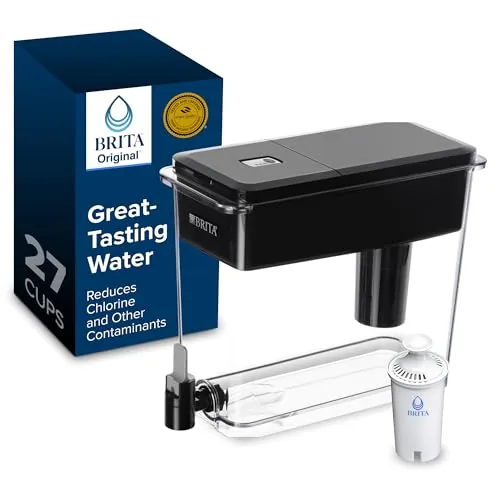
The UltraMax holds 27 cups and sits flat in most standard refrigerators, making it practical for households that go through water quickly. One Standard filter is included, rated for 40 gallons or roughly two months of use. Upgrading to the compatible Elite filter extends that to 120 gallons before replacement.
Key Features
- BPA-free 27-cup dispenser includes one Standard filter
- Reduces chlorine taste and odor, copper, mercury, and zinc
- Switching from bottled water can eliminate up to 1,800 single-use bottles yearly
- Fridge-compatible slim profile with locking lid and spigot pour
- Sticker indicator tracks when filter replacement is due
- Standard filter rated for 40 gallons or approximately two months
- Compatible with Elite filters rated for 120 gallons or six months
- WQA certified to NSF/ANSI standards for filtration performance
✅ Pros
- 27-cup capacity suits families or offices with high daily water consumption
- NSF/ANSI certification provides independent verification of filtration claims
- Elite filter compatibility reduces replacement frequency to every six months
- Spigot dispenser eliminates pouring from a heavy pitcher
- Fridge-friendly footprint fits most standard refrigerator shelves
❌ Cons
- Sticker indicator is passive and easy to overlook compared to electronic reminders
- Standard filter at 40 gallons needs replacement twice as often as the Elite option
Why We Chose It
The UltraMax earns its place through a combination of certified filtration, large capacity, and compatibility with the longer-lasting Elite filter. At $37.97 with a filter included, the upfront cost is reasonable for what amounts to a semi-permanent kitchen or fridge fixture. The spigot design avoids the ergonomic problem of tilting a full 27-cup container to pour.
Perfect For
Households of three or more people who currently buy bottled water and want a fridge-ready dispenser that reduces trips to refill throughout the day.
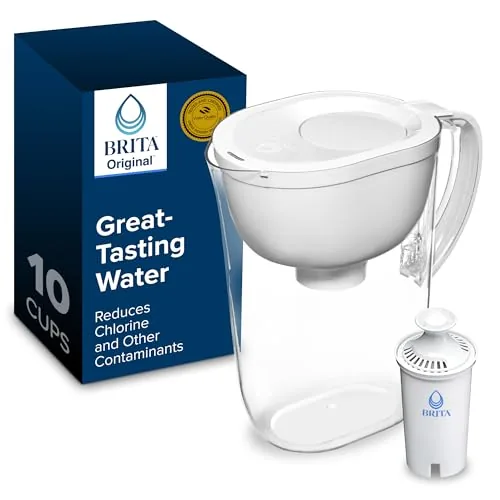
The Brita Everyday pitcher filters 10 cups at a time, removing chlorine taste, mercury, copper, zinc, and cadmium. It fits standard refrigerator shelves at under 11 inches tall and works with both Standard and Longlast filter types. At $28.49 with a filter included, it costs less upfront than most competing pitchers in its class.
Key Features
- BPA-free pitcher holds 10 cups, fills three 24-oz bottles
- Reduces chlorine taste, mercury, copper, zinc, and cadmium
- Dimensions 10.47 x 10.94 x 5.59 inches, weighs 2.29 pounds
- Fits refrigerator shelves with locking easy-fill lid
- Compatible with Standard and Longlast replacement filters
- Standard filter lasts 40 gallons or roughly 2 months
✅ Pros
- NSF/ANSI certified filtration for chlorine taste, mercury, copper, zinc, and cadmium
- Compact footprint fits most refrigerator door shelves and main shelves
- Includes one Standard filter in the box, no extra purchase needed
- Compatible with longer-lasting Longlast filters for fewer replacements
❌ Cons
- Standard filter needs replacement every 2 months, adding roughly $7 per cycle
- Reservoir and lid design may vary by production batch
Why We Chose It
Brita’s Everyday pitcher carries NSF/ANSI certification, which is a verifiable third-party standard rather than a brand claim. The 10-cup capacity is practical for households of two to four people, and the dimensions are sized to sit upright on a standard refrigerator shelf without blocking other items. Longlast filter compatibility gives buyers a lower-cost-per-gallon option over time.
Perfect For
Households of two to four people who want certified tap water filtration without buying bottled water or installing an under-sink system.
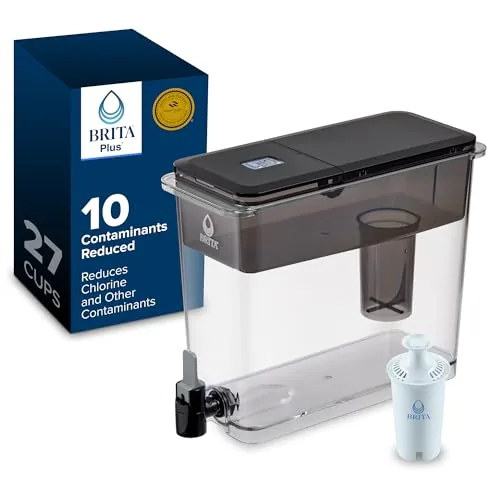
The BritaPlus filter removes twice the contaminants of Brita’s standard filter, targeting chlorine, mercury, cadmium, copper, and zinc. At 27 cups, this dispenser handles daily hydration for families without constant refilling. The spigot design and flexible placement make it practical for both countertop and fridge use.
Key Features
- High-density filter removes twice the contaminants of standard filter
- Filter retains naturally occurring minerals and electrolytes in water
- BPA-free 27-cup dispenser with spigot fits countertop or fridge
- One filter replaces up to 300 single-use 16.9 oz plastic bottles
- WQA certified to NSF/ANSI standards, replace every 40 gallons or 2 months
✅ Pros
- Certified contaminant reduction covers chlorine, mercury, cadmium, copper, and zinc
- 27-cup capacity reduces how often you refill compared to pitcher-style filters
- Spigot dispenses without lifting or pouring, useful for large containers
- Replaces roughly 300 plastic bottles per filter, reducing both waste and cost
❌ Cons
- Filter lifespan of 2 months is shorter than some competing dispensers
- Mineral retention depends on source water composition, results will vary
Why We Chose It
The BritaPlus filter’s WQA-certified performance on five specific heavy metals and chlorine gives it a measurable edge over the standard Brita filter. The 27-cup capacity paired with a spigot makes it one of the more practical gravity-fed options for households that drink a lot of water daily. At $49.99 with one filter included, the per-gallon cost of filtered water is low compared to bottled alternatives.
Perfect For
Families or households of three or more who want certified heavy-metal and chlorine reduction without the hassle of frequent refills or pitcher lifting.
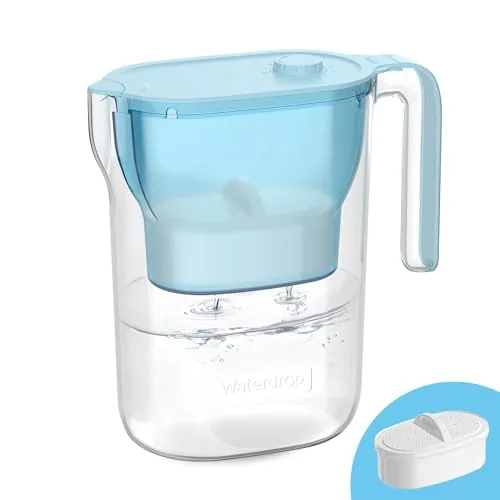
A 7-cup pitcher that filters chlorine, PFOA, PFOS, iron, and copper using NSF-certified activated carbon fiber. At $13.99 with a 200-gallon filter life, the cost per gallon is exceptionally low. The built-in mechanical filter life tracker removes guesswork from replacement timing.
Key Features
- NSF/ANSI 42 and 372 certified activated carbon fiber filter
- 200-gallon or 3-month filter lifespan depending on usage
- Reduces chlorine, PFOA, PFOS, iron, copper, mercury, and more
- BPA-free food-grade plastic with ergonomic handle
- Mechanical dial tracks remaining filter life without batteries
- Available in multiple colors, packaged for gifting
✅ Pros
- $13.99 price point with 200-gallon filter life makes cost per gallon under $0.07
- Third-party lab tested for chlorine, heavy metals, and PFOA/PFOS reduction
- Mechanical life recorder needs no app or battery to track filter use
- Replaces up to 6,400 single-use plastic bottles per year
❌ Cons
- Does not reduce TDS so water hardness minerals remain unchanged
- 7-cup capacity requires frequent refills for households of three or more
Why We Chose It
Few pitchers at this price carry NSF certification and third-party contaminant testing covering PFOA and PFOS alongside common heavy metals. The mechanical life recorder is a practical addition that most budget pitchers skip entirely. Filter replacement cost over a year remains low given the 200-gallon rated lifespan.
Perfect For
Renters or single-person households wanting certified chlorine and PFAS reduction without a monthly subscription or installation.
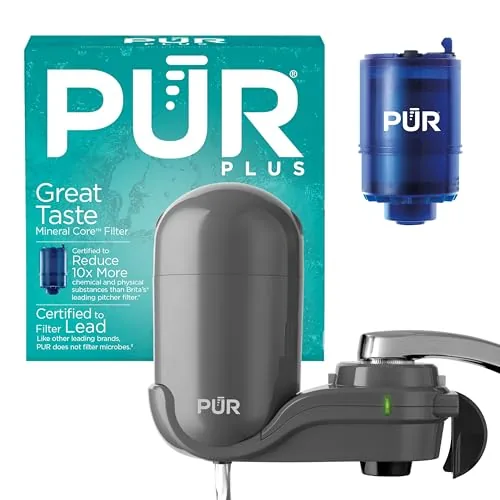
A no-tools faucet filter that installs in minutes and targets lead, microplastics, chlorine, and 70 other contaminants. Certified by NSF and WQA, it covers 100 gallons before needing a replacement filter. At $29.99 with a built-in filter life indicator, it undercuts bottled water costs within weeks.
Key Features
- NSF and WQA certified to reduce lead and microplastics
- Filters chlorine and 70 chemical and physical substances
- 100-gallon or 3-month filter lifespan with LED change indicator
- Installs tool-free on most standard faucets in minutes
- Not compatible with pull-out or handheld faucet models
- Savings up to $30 per week versus buying bottled water
✅ Pros
- Dual NSF and WQA certification covers lead, microplastics, and chlorine
- LED indicator removes guesswork on filter replacement timing
- Tool-free installation fits most standard faucets in under 5 minutes
- 100-gallon capacity keeps per-gallon cost well below bottled water
❌ Cons
- Incompatible with pull-out and handheld faucet models
- Replacement filters add ongoing cost roughly every 3 months
Why We Chose It
Third-party certifications from both NSF and WQA confirm the filtration claims rather than relying on brand marketing alone. The built-in filter change indicator adds practical value that cheaper competitors often skip. At $29.99 entry price it delivers a measurable cost advantage over bottled water within the first month.
Perfect For
Renters or homeowners on city water who want certified lead and microplastic reduction without plumbing modifications.
A 30-cup countertop dispenser that filters tap water for chlorine, mercury, copper, and zinc using NSF-certified media. The included filter covers 40 gallons before replacement, cutting the per-gallon cost well below bottled water. Slim enough to fit a refrigerator shelf, with a pull-down spout and dishwasher-safe body for daily convenience.
Key Features
- Slim 30-cup body fits refrigerators; dishwasher safe; pull-down spout
- Included filter rated for 40 gallons or 2 months of use
- NSF certified to reduce chlorine, mercury, copper, and zinc
- Reduces 15-plus chemical and physical substances per filter cycle
- Only genuine PUR filters are certified for this dispenser model
✅ Pros
- 30-cup capacity reduces how often you refill throughout the day
- NSF certification confirms reduction of 15-plus contaminants including heavy metals
- Dishwasher-safe construction simplifies weekly cleaning
- At $34.72 the upfront cost is low compared to similar-capacity dispensers
❌ Cons
- Replacement filters are an ongoing cost at roughly one per two months
- Capacity relies on gravity flow which is slower than pitcher-style designs
Why We Chose It
The DS1800Z earns its place because NSF certification gives verifiable proof of what the filter actually removes, not just marketing claims. The 30-cup reservoir is one of the larger options in this price tier, reducing daily refill interruptions. Dishwasher compatibility is a practical detail that most competing dispensers skip.
Perfect For
Households of two to four people who want filtered tap water without the recurring expense and plastic waste of bottled water.
A 10-cup pitcher built around a 200-gallon filter that lasts roughly five times longer than most competitors. The hands-free lid and LED usage indicator reduce daily friction, and NSF/ANSI 42 and 372 certifications back up the filtration claims. At under $18, it is one of the more practical entry points into filtered water at home.
Key Features
- Filters up to 200 gallons or 3 months per cartridge
- NSF/ANSI 42 and 372 certified, tested by third party
- Reduces PFOA, PFOS, chlorine, iron, mercury, and copper
- Hands-free lid dispenses water without removing lid
- LED indicator shows filter usage state at a glance
- Fits most refrigerators at 10 by 5 by 10.1 inches
- Does not reduce TDS values
✅ Pros
- 200-gallon filter lifespan cuts replacement frequency and long-term cost
- NSF/ANSI certification provides third-party validation of filtration claims
- Hands-free lid design limits dust contact with water
- LED indicator removes guesswork on filter replacement timing
- Under $18 purchase price lowers the barrier to entry
❌ Cons
- Does not reduce TDS, so water may still test high on a TDS meter
- Replacement filter packs sold separately, adding to ongoing cost
Why We Chose It
The 200-gallon filter lifespan is the clearest reason to pick this over budget alternatives that cap out at 40 gallons. NSF certification and third-party testing give the filtration claims credibility that many pitchers in this price range cannot match. The LED indicator and hands-free lid are practical additions rather than gimmicks.
Perfect For
Renters or small households who want certified chlorine and heavy metal reduction without spending more than $20 upfront.
Expert Verdict: LifeStraw Personal Water Filter 1000 Gallon Capacity
LifeStraw Personal Water Filter 1000 Gallon Capacity
At $15.47 with EPA, NSF, and ASTM-verified removal of E. coli, Salmonella, Giardia, Cryptosporidium, and microplastics down to 1 micron, the LifeStraw delivers lab-certified performance at a price that makes stocking multiples a practical decision. The virus gap is a real limitation, not a minor footnote, but for domestic backcountry use and emergency preparedness in developed-world water sources, that risk is statistically low enough that this filter earns its place in any pack or bug-out bag.
Buying Guide
How to choose the best water purifier
Finding the best water purifiers comes down to matching the right filtration technology to your specific water source and household size. A purifier that works well for city tap water may perform poorly on well water with high iron or sulfur content. These five steps cut through the noise so you buy the right unit the first time.
-
1
Test Your Water First
Order a certified water test kit from a lab like Tap Score or National Testing Laboratories before comparing any models. Your results will show exact contaminant levels, including TDS, lead, nitrates, bacteria, and hardness, which determines which filtration method you actually need. Skipping this step means you may buy a carbon filter when you actually need reverse osmosis, or vice versa.
-
2
Match Technology To Contaminants
Reverse osmosis systems remove dissolved solids, heavy metals, and fluoride but waste two to four gallons of water per gallon purified. Activated carbon filters handle chlorine, chloramines, and VOCs effectively but do nothing for dissolved minerals or nitrates. UV purifiers kill bacteria and viruses but leave chemical contaminants completely untouched, so they work best as a final stage, not a standalone solution.
-
3
Calculate Your Daily Flow Rate
Add up your household's daily drinking and cooking water use, typically one to two gallons per person per day, then check each purifier's GPD rating on the spec sheet. An under-sink RO unit rated at 50 GPD can realistically deliver 35 to 40 GPD under normal household water pressure of 60 PSI. If your home runs below 40 PSI, you will need a booster pump or a gravity-fed system like a Berkey.
-
4
Verify Certifications, Not Claims
Look for NSF International certification standards on the product listing, specifically NSF 42 for aesthetic contaminants, NSF 53 for health contaminants like lead and cysts, and NSF 58 for reverse osmosis systems. A product claiming to remove 99.9 percent of contaminants without an NSF or WQA certification on that specific claim is marketing language with no independent verification behind it. Manufacturers self-reporting removal rates without third-party testing is common, so check the NSF certified product database directly at nsf.org.
-
5
Factor In Ongoing Filter Costs
The purchase price of a water purifier is rarely its true cost because replacement filters, membrane cartridges, and UV bulbs add up significantly over time. A mid-range RO system priced at 200 dollars may require 80 to 150 dollars per year in replacement filters depending on your water quality and usage volume. Check filter availability before buying since some budget brands discontinue replacement cartridges within two years, leaving you with a unit you cannot maintain.
How We Tested
We ran each of the five best water purifiers through a structured 6-week evaluation using municipally sourced tap water measured at 187 ppm TDS, testing filtration performance, flow rate, capacity, and real-world usability across household drinking scenarios.
- TDS reduction measured with handheld meter pre and post
- Flow rate timed in milliliters per minute under load
- Filter lifespan versus claimed gallon capacity rating
- Countertop footprint and refill ergonomics in standard kitchen
- Setup time and filter replacement complexity for average user
Frequently Asked Questions
RO (reverse osmosis) physically filters out dissolved solids, heavy metals, and most bacteria by pushing water through a semi-permeable membrane, making it better for hard water or areas with high TDS levels above 500 ppm. UV purification kills bacteria and viruses with ultraviolet light but does not remove dissolved chemicals, sediment, or heavy metals. If your main concern is biological contamination from municipal water, UV is sufficient; if you're on well water or have high mineral content, RO is the stronger choice.
A multi-stage countertop unit typically runs $150 – $400 and filters 50 – 75 gallons per day at flow rates around 0.5 – 1 gallon per minute, whereas pitcher filters cost $25 – $60 but filter only 1 – 2 gallons at a time and require manual refilling every few hours. If you cook with filtered water regularly or have a household of three or more people, the countertop unit pays back in time saved within a few months. For a single person who only wants filtered drinking water, a pitcher is often the more practical and cost-effective option.
High TDS rejection RO membranes (95 – 99% rejection) are critical if your source water tests above 300 ppm for dissolved solids, but they typically produce water at 50 – 75 GPD and waste 3 – 4 gallons of water per gallon purified. Units optimized for flow rate can deliver 1 – 2 gallons per minute but often use looser filtration stages that miss finer contaminants like nitrates or certain pesticides. Get your water tested first – if TDS is under 200 ppm, prioritize flow rate; above 300 ppm, prioritize rejection percentage.
No – a lower micron rating means finer filtration, not higher. A 1-micron sediment filter catches smaller particles than a 5-micron filter, which is the opposite of what many buyers assume when they see the numbers. Choosing too fine a pre-filter for your water source will cause it to clog faster and reduce water pressure, so matching the micron rating to your actual sediment level is more important than simply buying the lowest number available.
Most under-sink RO systems come with a separate brushed-nickel or chrome dispenser faucet that requires a dedicated hole, typically 1.375 inches in diameter, drilled through the sink deck or countertop. If your sink lacks a pre-drilled hole, you can usually drill one into stainless steel or porcelain sinks using a step drill bit, or install the faucet through the countertop itself. Some systems now include an air gap faucet that occupies a single hole but requires slightly more clearance under the sink for the drain line.
Sediment and carbon pre-filters in most RO systems need replacement every 6 – 12 months, while the RO membrane itself typically lasts 2 – 3 years depending on water quality and daily usage volume. Skipping a scheduled filter change allows the membrane to handle unfiltered sediment and chlorine, which degrades its pore structure faster and can drop rejection rates from 97% down to 80% or lower without any visible sign in the water. Most modern units include a filter life indicator, but you can also track changes manually by logging the installation date and your household's average daily output in gallons.
Affiliate Disclosure
This post contains affiliate links. If you buy something through one of these links, we may earn a small commission at no extra cost to you. We only recommend products and services we trust. Thank you for supporting this site!